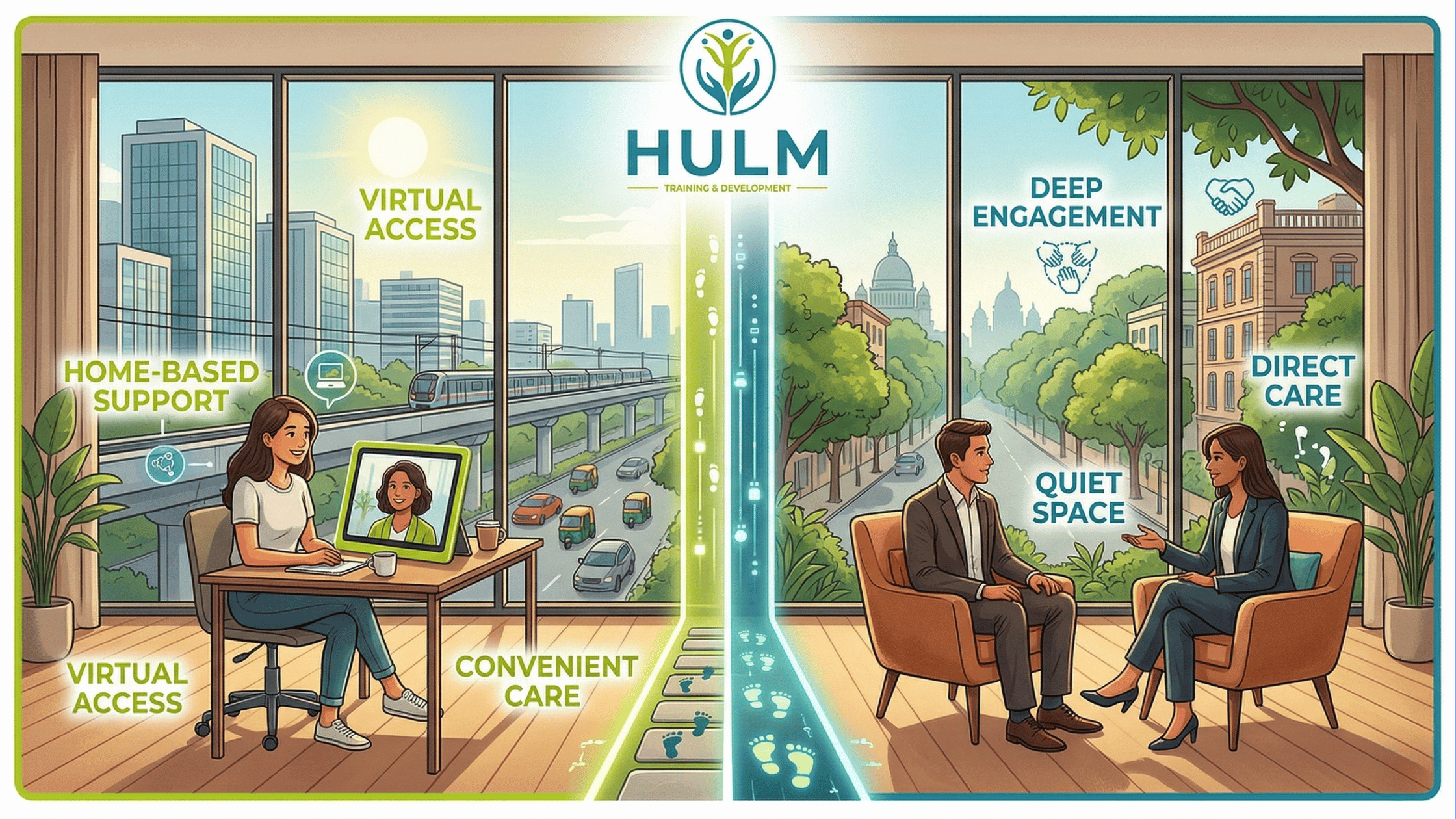
Online Counselling vs In-Person Therapy: What Works Better for Bangalore Clients?
People have strong opinions about this. Stronger than the question probably deserves. The truth is, most people in Bangalore aren't making this decision philosophically. They're making it because their Tuesday is already a disaster, and adding a 45-minute commute to a therapy clinic feels genuinely impossible. That's the real starting point for most people, not research, not preference. Just the week they're having.
The Case for Online Counselling
The most obvious thing about online therapy is convenience. But that word undersells it a little.
For someone already running on fumes, the idea of blocking out two hours for travel plus a session is sometimes the exact reason they keep postponing it. Online removes that. The session fits into the day instead of reorganizing it. And honestly, that's what keeps people coming back regularly, which is the part that actually makes therapy work.
Something to do with familiarity as well. Others are more relaxed in their own surroundings. There is some social pressure that accompanies sitting in a room with a stranger, even a trained and kind one, which not everyone processes in the same way. At home, when on a call, that pressure is slightly reduced. Others find that they say things online that they would not have said in real life, at least not that quickly. That being said, online sessions do not suit everyone.
What Face-to-Face Therapy Does Not Do?
It is something about being physically present with someone that a screen simply cannot duplicate. Not that the therapy is different, but that presence conveys things that words do not.
A therapist sitting across from you notices how you're holding your body, whether you went quiet for a second before answering. Whether something shifted in your face when a particular topic came up. That non-verbal information feeds into how a good therapist guides a session. Some of it gets lost on video calls, not all of it, but some.
Face-to-face sessions have a different weight for couples. The presence of two individuals in a room in the company of a professional makes it a more difficult environment to withdraw. During a video call, one participant may become silent, and the other one cannot be sure whether it is the connection or something else. Face-to-face, one has no place to hide anymore. That can actually be useful.
What Bangalore Clients Specifically Deal With
Most people here aren't picking a format based on research. They're picking based on what their week looks like. Sometimes that changes month to month. That's fine, most good therapists will work around it.
An individual who does a hybrid work arrangement may have online sessions on Tuesday evenings and realise that it suits months. A person experiencing something acute, a relationship crisis, or a grief process, may be in need of the physical vessel of an in-person session to feel grounded enough to get deep.
Format is probably the least important variable in this whole conversation. Whether someone improves has much more to do with whether they show up consistently and whether they actually connect with their therapist. A brilliant therapist on a grainy video call will still do more good than an average one in a beautifully designed office.
The Hybrid Approach
This doesn't get talked about enough. A lot of people do both.
Start online because it's easier to begin. Then move to in-person once the relationship with the therapist is established, and the initial awkwardness has passed. Or do mostly online with occasional in-person sessions during harder periods. There's no rule that says you have to pick one and stick with it.
Therapeutic alliance builds the same way regardless of where the session happens. It comes from honesty on the client's side and genuine attention on the therapist's side. A screen doesn't block that. Neither does an office guarantee it.
Questions Worth Asking Before You Decide
Before picking a format, a few things are worth sitting with.
How private is your home environment? If you're in a shared flat or a joint family setup, online sessions might feel less safe than they would for someone with their own space. Does your schedule allow for travel to a clinic? Not just once, but weekly or fortnightly, consistently? And what kind of support are you seeking? Someone working through something specific and time-bound might do well online. Someone exploring deeper, longer-standing patterns might benefit from the grounded presence of in-person work.
There's no wrong answer here. Some people try online first because starting feels less intimidating that way. Others need the physical commitment of showing up somewhere to take it seriously. Both are valid reasons. Neither says anything about how the therapy will go.
HULM Training and Development provides both. Face-to-face classes are operated in BTM Layout and J.P. Nagar, Bangalore. There are online sessions that can be used by those who require flexibility. Regardless of whether the person is coming in to receive individual therapy, couples counselling, or something that they have not yet quite labelled, the method remains the same: client-centred, confidential, and, in fact, concerned with what is going on in the life of that particular person. Nabeel Ahmed Baig constructed HULM in 2017 based on that belief, and it remains evident in the way the work is done.
You can sit on the fence about format. Choose the one that is easier to begin with. The most important part is the starting.
Both online counselling and face-to-face therapy are effective. The distinction is in what each format can enable a particular individual in a particular circumstance. Bangalore customers tend to manoeuvre the option depending on time, privacy and the type of work they are going through. HULM Training and Development provides both formats, so it is easier to start with either format that feels comfortable.
FAQs
1. Is online counselling effective as compared to face-to-face therapy?
For most people, yes. Studies have always indicated that results are similar in both forms. It is the regularity of attendance and quality of the relationship with the therapist that is important and not whether the session is on a screen or in a room.
2. What is the format that I feel more comfortable with?
Begin with your time and your residence. In-person is better in case privacy at home is minimal, or you require the formality of physically appearing somewhere. In case travel is a real impediment to consistency, then online is the wiser place to begin.
3. Is it possible to have online and in-person sessions with the same therapist?
The majority of therapists are flexible, and so is the case with HULM. Life evolves, timetables change, and what was effective in one season might not be effective in another season. The therapeutic relationship remains intact in spite of the location of the session.
4. What should I do in case I am not comfortable opening up during a video call?
The unpleasantness normally disappears in a session or two. Online sessions do become easy for some people after they get settled. When it really does not work after a couple of attempts, it is always possible to change to face-to-face with the same therapist, which is always worth discussing.